A small ball of mass 2 × × 10 -3 kg having a charge of 1 µC is suspended by a string of length 0.8 m. Another identical ball having the same charge is kept at the point of suspension. Determine the minimum horizontal velocity which should be imparted to the lower ball so that it can make complete revolution. ¼g = 10 m/s 2 )
Text Solution
Verified by ExpertsCHECK THE SOLUTION.
(  = 5.86 m/s)
Given, q = 1µc = 10 –6 C
& m = 2 × 10 –3 Kg and
λ = 0.8 m
Let u be the speed of the particle at its lowest point and v its speed at highest point.
At highest point, three forces are acting on the particle.
(i) Electrostatic repulsion
F e =  .
.  (outwards)
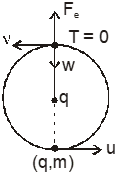
(ii) Weight W = mg (inwards), and
(iii) Tension T (inwards)
T = 0, if the particle has just to complete the circle and the necessary centripetal force is provided by
W – F e i.e.,  = W – F e
or v 2 = 
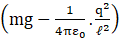
v 2 = 
 m 2 / s 2
or v 2 = 2.4 m 2 / s 2 .....(1)
Now the electrostatic potential energy at the lowest and highest points are equal. Hence from conservation of mechanical energy
Increase in gravitational potential energy = Decrease in kinetic energy
or mg(2l) =  m (u 2 – v 2 )
or u 2 = v 2 + 4 gl
Substituting the values of v 2 from equation (1) we get
u 2 = 2.4 + 4 (10) (0.8) = 34.4 m 2 / s 2 .
∴ u = 5.86 m/s
Therefore, minimum horizontal velocity imparted to the lower ball, so that it can make compete revolution, is 5.86 m/s.
Prepare Smarter with CGP Edu
Get practice questions, solutions, and test series in one place.
Write a Review
Share your experience with this question and solution.
Commentary
Send your comment, doubt, correction, or feedback to admin.
Similar Questions
Explore conceptually related problems